
2025
What Would Give Me the Right to Tell This Story?
When they want to make a point, many people look for a story to illustrate it.
They think, “I want to talk about persistence, so let me find a persistence story.” And they end up telling the same story about Lincoln’s long string of failed campaigns and political setbacks that everyone else tells.
The problem with that approach is that it’s deductive storytelling. You’ve chosen the moral first and then gone hunting for a story that fits. That leads to hearing the same tired stories over and over again. You’re just borrowing from work that’s already been done.
I teach leaders and speakers to do the opposite. I tell them to start with the story that fascinates them and then ask, “What would give me the right to tell this story? How could I earn it?"
In other words, what does this story teach me or reveal to me that I didn’t see before? What’s the part of the story that never makes it into the headline, but changes how I see it?
That’s the difference between inductive and deductive storytelling. But I don’t think of it in those terms. I think of it as letting the object lead. The story is the object. You don’t impose a lesson on it. You let the lesson emerge from it. You let it show you what you didn’t know.
This approach is not really a technique. It’s more a way of living. You keep your eyes open for stories you’d want to tell, whether you know why or not, and you hold onto them. Later on, you figure out why they’re important to you, and that importance becomes the lesson.
By the way, an outgrowth of this approach: a writer named Lou Willett Stanek once wrote, “Stories only happen to the people who can tell them.” So as you go looking for stories, you start seeing the world in stories.
True Stories No One Asked For
I found a document I’ve kept since 2009.
It’s only a few pages long, and I’ve rarely opened it. I didn’t keep it faithfully or systematically. And yet, somehow, these stories found their way into it. I’ve changed some names.
What follows is that document, lightly edited and rearranged.
◦
Dan told me a story from his life as a police officer.
A woman said it had been days since she’d seen her neighbor, Henderson. Dan went to Henderson’s apartment for a wellness check. No answer. He broke in and found Henderson’s body on the floor, bloated and decomposing.
It was the middle of the day, the sun was shining brightly, but the apartment looked like the dead of night inside. The windows were thickly covered with houseflies, blotting out the light.
◦
Lena told me about her Uncle Ray, who has shrapnel embedded under one eye.
Fifteen years earlier, Ray had been carjacked in Los Angeles and refused to hand over the car. He told the carjacker the car wasn’t his, it was a rental, so he couldn’t give it away. The carjacker shot him in the face.
The carjacker took Ray’s wallet. Inside was a tattered piece of paper Ray had written himself, covered with single words. He called them “joke starters.” Each word was a prompt that jogged his memory for a specific joke. He’d glance at a word like linguini and launch into the one that went with it.
At family gatherings, the kids would crowd around him asking for jokes. By the fourth or fifth joke, they’d wander off bored.
After the carjacking, Ray started a new joke-starter paper.
◦
I saw a news story about an attempted armed robbery.
A 22-year-old gunman entered a check-cashing store, jumped the counter, and pointed a gun at the only employee, a woman who immediately began crying and praying out loud.
The gunman panicked, dropped the gun, and prayed with her. They hugged.
Then he handed her the gun’s single bullet, left the store, and turned himself in.
◦
I watched an ABC News video that played a 911 call.
A seven-year-old boy had locked himself and his little sister in a bathroom while three armed men held their parents at gunpoint in another room. The boy called 911. The dispatcher told him police were on the way.
The boy said: “Send soldiers, too."
No one ended up being seriously hurt.
◦
At the gym, Mara told me that when she was a kid, her parents took her to a casino and gave her a few coins to play the slot machines. On her first coin, she hit a jackpot. Her father told her to quit. She tried a second coin and hit another jackpot.
Mara’s mother gambled rarely. When she once hit a slot-machine jackpot herself, the flashing lights and clanging bells frightened her. She thought she’d broken the machine and fled the casino without collecting her winnings.
◦
I was sitting in Clinton Bagels when two tough-looking workmen came in wearing jeans, flannel shirts, tool belts, and baseball caps. They sat down for lunch.
About fifteen minutes later, a third man walked in from the parking lot, spotted them, and said, “Hey, you guys get a new truck?”
One of the tough-looking workmen said, “Same truck. New decals.”
◦
Erin was thinking about taking a trip to Egypt.
Caleb, who liked to joke while keeping a completely straight face, told her that five weeks earlier a group of mystics near one of the pyramids had held a ceremony and brought a mummy back to life.
“The mummy pushed someone,” Caleb said, “and took their suitcase.”
Erin asked, earnestly, “Really?”
◦
Stella finished eating her Chinese takeout and broke off a piece of fortune cookie for our Shiba Inu, Jofu.
As she bent down to feed him, the paper fortune slipped off the countertop and fell to the floor. Jofu ate that too.
The fortune had read, “A small gift will please the whole family.”
◦
I was writing in a WORD document and misspelled the name of the famed German philosopher, Heidegger.
Spellcheck suggested I change it to “Headgear.”
◦
A stink bug climbed the side of Stella’s soda glass.
Stella hates looking at bugs, but she also doesn’t like killing them, for ethical reasons. As she tried to shoo the bug into the kitchen sink, she said, “Get out of here, you stupid loser.”
Minutes later, our cat Jinx sneezed directly into Stella’s arugula salad. She threw the salad into the garbage.
◦
After his long run with the San Francisco Giants, outfielder Hunter Pence published a farewell note to the fans who had treated him so well. He opened with the following line:
“I definitely wish some of the greatest times in our lives could go on forever and somehow, I believe they do.”
Begin With Your Conclusion
Let’s start by giving away the punchline: When you speak or pitch or write, begin with your conclusion.
I originally learned this strategy from Edward Bailey’s “The Plain English Approach to Business Writing.” There’s nothing fancy about it. It’s almost offensively simple. And it works. Here’s what I mean.
Imagine someone from your department walks into your office and says, “I have something important to tell you.” You put aside the five things you’re working on. He continues:
“The other day I was in Manhattan. I was eating at a restaurant in the theater district, and I saw a friend I hadn’t seen in years. His name is Ricky. He’s a big-time lawyer now. So Ricky comes over to my table, I’m eating eggplant parm, and we start talking about old times. Something he says, though, triggers a memory from when we were in high school . . . ”
Let’s pause there.
If you were listening to this, what would you be thinking? Me? I’d be thinking: Manhattan. Ricky. Lawyer. Eggplant parm. Got it. Why are you telling me this?
If he keeps going, you get antsy. Then irritated. And here’s the important part: even if what he has to say is genuinely important, you have no way of knowing that yet. Why? He won’t tell you what he’s asking of you! So part of you just wants him to leave. We’ve all been on the receiving end of this. And if we’re honest, most of us have done it ourselves. Why does it happen?
One reason is that we present information the way we experienced it, instead of the way someone else needs to hear it. We’re asking the other person to do all the work of figuring out what matters.
Another reason is fear. We’re afraid to say the point up front. We worry the other person will judge it too quickly, or won’t understand how we got there. That fear feels prudent, but it isn’t. Hiding the point doesn’t make rejection less likely. It just makes the conversation harder to follow and easier to dismiss.
So try this instead: start with the conclusion, or the recommendation, or the main idea. Then explain yourself. It sounds like this:
“Hey, I think we should ask for a ten-day extension on this deadline. Here’s why.”
Or: “Instead of going to Florida this year, I think we should go to South Dakota. Here’s why.”
Now the listener knows what game they’re in. They can follow along, and agree or disagree. But they’re not guessing why you’re talking.
Looy on Grippo
While researching an article on Las Vegas magic in the late 1990s, I asked my friend Looy Simonoff about the colorful close-up magician Jimmy Grippo (1898–1992).
For the next two hours, Looy told me one Grippo story after another, each more extraordinary than the last. What follows are my notes from that conversation. They’ve been lightly edited for clarity and order, not substance. The stories, opinions, and judgments are Looy’s as I recorded and remember them. Any errors are mine.
—
Grippo had an unusual look about him. He had a glass eye, and he’d tell exotic stories about how he lost the real one. In truth, it happened when he was a kid, from a firecracker.
When Grippo was in his twenties, he had a fancy glass eye made, with diamonds around the iris. He’d take the eye out and ask someone to stare at it while he was trying to hypnotize them. As strange as that sounds, the eye wasn’t the most curious thing about his appearance. That was his hair.
Grippo always wore an obvious wig. It was jet black, thick, and combed into bangs all around his head. He wore this jet black wig even when he was very old. When I went to visit him in the hospital after his stroke, I saw the wig hanging on a hook by the bed. The funny thing was that his real hair looked almost exactly like the wig, only a little thinner on top.
That same stroke left Grippo’s left hand paralyzed, at least for a while. When he eventually regained movement in the hand, he didn’t tell anyone. Instead, he continued doing tricks with his good right hand, while his supposedly paralyzed left hand stole things and helped with secret loads.
Grippo’s reputation was built largely on challenges. He’d start a trick, look at the spectator, and say, “Now how do you want this to end?” The spectator would challenge him with something like, “Make it come out of my pocket,” or “out of my necktie.” And Grippo would do it.
I remember hearing about one time when Grippo and his friend Joe Condon walked into a jewelry store just as it was closing. The proprietor was on his knees by the open safe, counting the day’s receipts. Without hesitating, Grippo secretly scaled a playing card over the man’s head and into the safe just as it was being closed.
Condon then introduced Grippo to the proprietor, who said, “I hear you do great card magic.”
“Well, I try,” Grippo said.
Grippo then forced a duplicate of the card he’d already tossed into the safe. After that, he said, “Challenge me. Make me produce your card in some hard place.”
The proprietor said, “My pocket?”
“No,” Grippo said. “Real hard.”
The proprietor thought for a moment and said, “Can you make it appear in that safe?”
Grippo replied, “Well, I don’t know about that . . . ”
Grippo also used to do a challenge involving money. He always carried large amounts of cash and would bet people that he was carrying more money than they were. He always won.
One day, though, a big-shot gambler decided he was going to beat Grippo. The gambler had about twenty thousand dollars on him and went looking for Grippo. Unfortunately for the gambler, he bragged about it beforehand to Dai Vernon. Vernon tipped off Grippo, which gave Grippo time to prepare.
When the gambler finally found Grippo, he said, “Beat this,” and pulled out the twenty thousand dollars.
Grippo looked perplexed, then slowly began pulling crumpled bills and coins out of his pockets. About half an hour later, he finished by producing just enough money to beat the gambler.
Grippo was also a very good hypnotist. He used hypnosis in a weight-loss clinic in Florida to help elderly patients lose weight. He told me that whenever he got out of his car down there, crowds of overweight elderly people would gather around him, asking to be put under.
He also performed mock hypnosis stunts. You know the trick where you apparently cut your thumb and produce great amounts of blood before it heals up? Grippo did a variation of that trick when performing for doctors. He’d tell them he was hypnotizing himself, but instead of cutting his thumb, he’d apparently cut his throat. It looked terrifying. Then he’d make the wound “heal.”
At one point in his career, Grippo developed a tolerance for electric shocks and began using them in his hypnotic act. He concealed a Tesla coil on his body, took a spectator by the hands, and commanded the person to kneel. If the spectator resisted the hypnotic suggestion, Grippo would activate the coil and, using his own body as a conductor, shock the spectator into dropping to the floor.
He stopped using the coil when he learned it was causing him heart arrhythmia.
Grippo also managed prizefighters. The character Evil Eye Fleagle in the “Lil’ Abner” comic strip, who put hexes on opposing boxers, was modeled after him.
Grippo would stand ringside, staring at a boxer and waving his hands, apparently putting a spell on them. Later, he hypnotized Muhammad Ali and told him he was invincible. He also taught Ali magic.
Grippo was always telling stories, and every so often, one of the strangest ones would turn out to be true, which meant you never quite knew what to believe.
For example, he used to claim that he’d advised Roosevelt to call his radio talks “fireside chats.” That sounded implausible.
But Grippo also had a photograph of himself in the Oval Office, sitting at the President’s desk, with Jimmy Carter and Walter Mondale nearby, standing.
Confusing a Rule With a Goal
Years ago, I took a short standup comedy course in Manhattan. It ran for about three weeks, meeting twice a week. We wrote material, then performed it for the class in an old classroom.
At the end, there was a kind of final exam: five minutes on stage at Caroline’s on Broadway, the same club where Jerry Seinfeld, Louis C.K., Chris Rock, and Norm Macdonald had worked.
I was terrified. This was before I became a professional speaker. I wasn’t worried about bombing so much as freezing. Forgetting my jokes. Standing there unable to speak.
I went to see my comedy teacher, Stephen Rosenfeld, during office hours. He listened and said, “That’s perfectionism.” Then he gave me an analogy I’ve never forgotten.
He said perfectionism is like insisting you drive from Manhattan to Cape Cod without making a single left turn. (Manhattan and Cape Cod are 250 miles apart. On a good day it’s a five-hour drive.) “What does not making a left have to do with getting to your destination?” he asked. “Nothing. If you want to get to Cape Cod, make as many left turns as you need.”
What struck me later was how easily we add a needless rule to what we’re doing and then treat it like a design requirement. As if the goal were “don’t make mistakes,” instead of “get to the place you want to go.”
Rosenfeld told me he’d seen performers give technically faultless sets that moved no one. And he’d seen others go on stage, forget their lines, pull notecards out of their pockets, shake, cry – and the audience loved them.
“You can give a strong performance while making mistakes,” he said. “Perfection isn’t necessary. It’s not even possible.”
What's Your Parlor Trick?
If you mention you’re a magician, you’re not asked for an explanation. You’re asked for a demonstration. “Let’s see a trick.”
That’s because magic is a demonstration business. You can’t just take someone’s word for it. Without a demo, there is no magic. You’re just making a claim. You have to prove yourself right then and there, with no time to prepare.
That idea, giving people an impromptu experience of your abilities, shows up all over my work as a differentiation consultant and business strategist. It’s why I often give clients an exercise I created called “What’s your parlor trick?” or sometimes, “What’s your Houdini trick?”
I ask them this: Suppose you’re at a party and you meet someone who could be critical to the future of your business. An important stranger. What could you do in five minutes that would give that person a visceral understanding of how good you are at your job?
Not a pitch. Not a résumé. An actual, on-the-spot demo. Something that makes them say, “Oh, wow. Now I get it.”
In other words, what small business-related miracle could you perform at the drop of a hat?
I once asked that question of a client who specializes in subscription models. So I tested her. I’d name a business. Any business. A manufacturer. A bicycle rental shop. A yoga studio. A niche software company. She’d pause for a beat, ask one or two precise questions, and then talk. In a few minutes, she’d lay out a subscription model that made the business feel crystal clear. Why someone would join. Why they’d stay. What would make it hard to leave. You could hear the logic click as she spoke.
That, repeated across wildly dissimilar businesses, was her demo.
Later, when it came time to write her books, the instinct wasn’t to explain subscription models in the abstract. It was to recreate that experience on the page. The range of examples came directly from those conversations. You could hear her thinking at work the same way you could when she was doing it live.
Most people try to explain why they’re good at what they do. Magicians know the explanation comes second. First, you show.
And the parlor trick is usually smaller than people expect. It’s often the thing you do so easily you don’t think it counts. Or the thing people keep coming back to you for. Or the part of your work that feels almost playful, which is why you’ve never formalized it. Those are usually the clues.
If you can’t do a small miracle in five minutes, it’s hard for people to believe in a bigger one later. And if you can, you don’t have to convince anyone of anything. Your parlor trick does the talking.
End Brake Retarder Prohibition
I’ve never in my life seen a four-word sentence made up entirely of constraining words. Then I noticed a traffic sign near my house: “END BRAKE RETARDER PROHIBITION.”
I love that phrase because it feels like an Easter egg I wasn’t meant to find.
End.
Brake.
Retarder.
Prohibition.
Every word is about stopping, slowing, restraining, or forbidding. It’s a sentence bursting with friction.
What makes it even better is that the sign appears as part of a two-sign sequence. A hundred or so yards earlier, there’s an initial traffic sign that reads: “BRAKE RETARDER PROHIBITION.”
So this first sign says no. The second sign says the no is over. And somehow the most restrictive-sounding sign of the two is the one that restores permission. Too cool!
When I looked it up, I learned that the phrase End Brake Retarder Prohibition is perfectly clear to the people it’s written for (truckers). It does exactly what it’s supposed to do.
I know I’m not the audience, and that’s part of the joy. It feels like I’ve stumbled across a sentence that escaped from a world I was never supposed to know about. Like it’s a gift.

Keep Your Slogan Simple
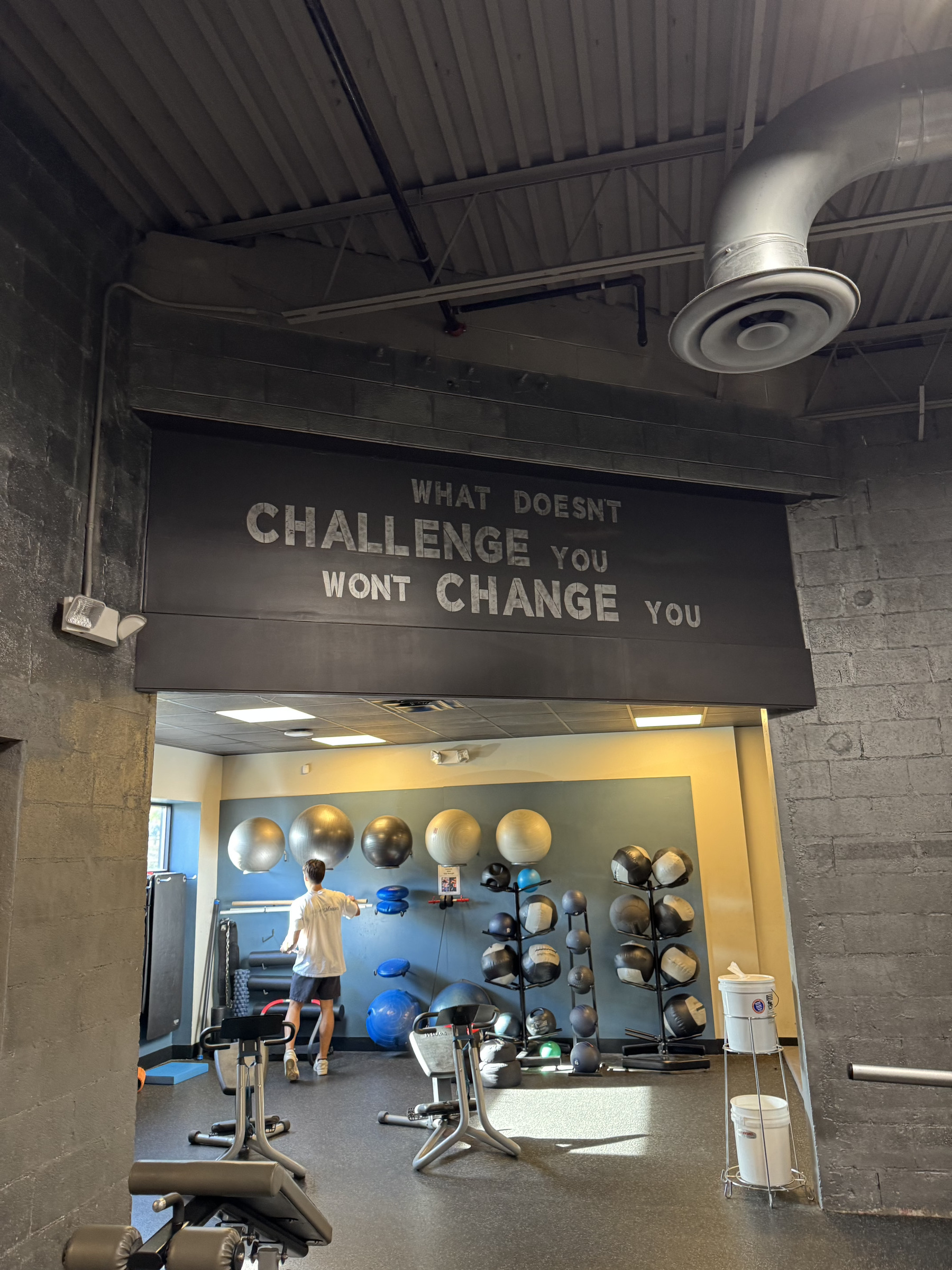
High up on a wall in my neighborhood gym, there’s a sign that reads:
“What Doesn’t CHALLENGE You Won’t CHANGE You.”
It’s the only permanent sign inside the gym, so you’d guess its message is important. It’s one whose wisdom the gym owners want stamped into people’s minds. And it’s painted in giant letters.
Which makes what comes next even stranger.
Gym-goers walk past that sign all day long without noticing it. Trust me, I’ve asked. Of the ten people I’ve quizzed, seven didn’t realize a sign was there at all, and the other three couldn’t recall what it said. (One did say, “It’s something about challenging yourself.”)
How could such a big sign be so invisible?
The sentence is loaded up with the negatives “doesn’t” and “won’t,” which slows comprehension down. The real problem isn’t the negatives themselves. It’s that the sentence has to be mentally flipped into a positive before it makes sense. That’s asking way too much.
What could the sign have said that would’ve been easy to absorb while you’re panting between sets? Here are a few that wouldn’t need conceptual translating:
No challenge, no change.
Struggle builds strength.
This is supposed to be hard.
Discomfort’s the point.
This is how folk wisdom catches on. Not because it’s smarter, but because it’s sayable. Everyone knows the idea behind “What you focus on grows.” But imagine if it had arrived as, “What you do not focus your attention on will not meaningfully improve for you.” Same idea. Dead on arrival. Wisdom spreads when it can be carried easily, especially by tired, distracted people. If it needs translating, it doesn’t travel.
There’s a reason slogans are simple. Nike didn’t say, “Consider the possibility of action.” They said Just Do It. Apple didn’t say, “We value creativity and nonconformity.” They said Think Different. Mel Robbins didn’t say, “What you don’t need to control in others won’t ultimately affect your well-being.” She said, Let Them.
Simple language sticks. If the message matters, make it impossible to miss – especially if your reader has just done five sets of box jumps.
33 Questions to Business Differentiation
Years ago, when I first started speaking professionally, friends told me I needed a lead magnet after my talks. Something simple. So I wrote this brief guide. At the end of a speech, then, I’d tell the audience that if they wanted a digital copy of “33 Questions to Business Differentiation,” all they had to do was hand me their business card and I’d send it along.
And damn if the guide wasn’t good! You really can uncover a true point of differentiation by following the advice and answering the questions. More than one person has told me that a single question in this guide changed how they talk about their business.
33 Questions to Business Differentiation
In the world of business, standing out isn’t an option. It’s essential. If your offering sounds like thousands or even millions of other offerings, you’re not giving the market any reason to choose you over your competitors.
To make your offering a success – be that offering a consulting project, product, service, book, or speech – your work needs to come across to the market as not just good, but different. What’s more, that difference can’t be trivial. It must have substance.
To help you create significant differentiation for your firm, or for any one of your offerings, I’ve compiled a list of questions that may lead you to the differentiation you’ve been searching for.
Using the list
Below, you’ll see 33 questions. Don’t try answering all of them at once. As a matter of fact, you may only need to answer a few. What you should do is this:
Read through the list. One question will jump out at you. That is, when you read it, you’ll feel the itch to answer it. Go ahead. Answer it.
Open your computer to a blank document or take out a pad and pen. Spend as little or as much time answering the question as you’d like. I’ve seen people take as little as a few seconds or as much as forty minutes to answer a single question.
When you’ve answered that question, again scan the list and see which question intuitively hits you next. Answer that new question. And so on. Keep going.
After an hour or so, put the list away and come back for another session later in the day, or even a few days later.
Once you’ve put in significant work, read over everything you’ve written and underline any ideas, words, phrases, and stories that strike you as promising. Does a single differentiating idea stand out, or can you string together a series of thoughts that lead to a differentiating idea?
If yes, think about all the ways you can use that idea to differentiate your firm and thought leadership pieces. If not, keep answering questions until a differentiator appears.
If you haven’t discovered a differentiator on your own, call upon a small group of your most trusted advisors, and share the best pieces from your written exploration. These advisors might help you see that you’ve already created a differentiator of potential.
A final note: On the list you’ll notice a few questions with a negative slant, such as “How might some of your pet business ideas be wrong?” The reason? I’ve found that when we approach a problem-solving situation from one vantage point only, we get stuck. By thinking about what we don’t like and where we might be wrong, we create room in our minds to mull over interesting ideas we wouldn’t have considered before.
The 33 Differentiation Questions
• Why did you begin your current business?
• Who is your ideal audience?
• How is your ideal audience different from other audiences?
• What can a member of your ideal audience do once you’ve worked with them that they couldn’t do before?
• What does your ideal audience need to hear from you most?
• What makes you the perfect person to deliver your work?
• What about your work is obvious?
• What about your work is surprising?
• Who admires your work, and why do they admire it?
• Whose work do you admire, and how have they influenced you?
• What business ideas do you most envy?
• What client problems do your competitors solve that you don’t?
• What are your pet business ideas, and why is each important to you?
• How might some of your pet business ideas be wrong?
• How does your work make a difference to others?
• How does your work make a difference to you?
• What part of your business do you most enjoy?
• What part of your business do you hate?
• What moments in business have made you most proud?
• What moments outside of business have made you most proud?
• What are your favorite business stories?
• What is the worst advice about your topic you’ve ever heard?
• What do you know about your topic that others don’t know?
• What do you know about your topic that others may know, but haven’t thought to say?
• What obstacles have you overcome?
• What are your weaknesses, and how might they be turned into strengths?
• Where in business have you shown courage?
• Where outside of business have you shown courage?
• What two changes would make the biggest difference to your business?
• What part of your work is underappreciated?
• What part of your work brings the most compliments?
• What is the greatest work-related compliment you’ve ever received?
• Over the next three years, if you could only teach your audience about one idea, what would that idea be?
The Existential Close
I created a sales technique called the existential close.
Now, I hate sales techniques. At least the kind that box people into a corner. The only techniques I like are the ones that make things clear and help people come to a fair decision. I’m very open.
Sometimes I’m talking to the leader of a billion-dollar product manufacturer. Other times I’m talking to someone thinking carefully about their own personal brand. The stakes are different, of course, but they’re experiencing the same human moment. They’re hesitating. If that happens, I’ll sometimes say something like this:
“You don’t want to do this until you’re ready. That makes sense. But there are a few things you should know.
“I’m really good at what I do. Differentiation is my craft. And the fact that you found me at all is wild. There are eight billion people on the planet. That you found me, decided I might be able to help, and reached out defies the mathematical odds.
“You might be thinking, ‘I can always do this later. There might be a better time.’ Maybe. But just because I’m here now doesn’t mean I’ll always be here. I might have a stroke. I might have an accident. I might decide to leave this field and do something else. I might decide to quadruple my fees.
“You just don’t know.
“What you do know is that I’ve already demonstrated I can help you in a meaningful way. You’ve said that yourself. And just because the opportunity exists now doesn’t mean it will exist later. If you walk, that’s not a neutral choice. It’s a gamble.”
I didn’t learn the existential close in any sales manual. I’m not trying to scare anyone. I’m not talking about their mortality. I put it all on me. I’m just naming something true about the human condition: things change, people disappear, and windows close.
Whatever they decide, I’m at peace with it. I told the truth.
The Best Car Chase Ever Done
William Friedkin was a young director still trying to figure out who he was. By 1970, he’d made a handful of films across very different genres, none of them quite connecting. One of them was “Good Times,” a lightweight movie starring Sonny and Cher. Friedkin later said he was so embarrassed by it that he wanted to buy up every existing print and destroy them.
In other words, he didn’t have a style. He was trying things, missing, and running out of runway.
Around that time, Friedkin was dating the daughter of Howard Hawks, which gave Friedkin access to one of the great American directors, a man who had made “Sergeant York” and “The Thing from Another World.” According to Hollywood lore, Friedkin asked Hawks what he should do next.
Hawks didn’t talk about grand visions. He said something much more blunt and tactical:
“People like car chases. Make the best one anyone’s ever done.”
Friedkin later clarified that Hawks may not have said those words exactly, and that the famous chase in “The French Connection” emerged from his own work with collaborators, not from a single piece of advice. Fair enough. But the story has endured because it captures what Friedkin actually did next.
He didn’t try to announce who he was as a serious filmmaker. Instead, he focused on doing one thing extremely well. “The French Connection” became the third highest-grossing film of 1971, won the Oscar for Best Picture – and featured what’s still considered one of the greatest car chases ever put on screen.
That chase didn’t just impress audiences. It shocked them. By getting one defining moment irrefutably right, the rest of the film was judged through that lens.
This is the power of creating something – not balanced and mundane – but unbalanced and unforgettable. It’s the restaurant with a decent menu that becomes legendary for a single, astonishing dessert. It’s the otherwise prosaic pop song that becomes a stadium anthem because of one killer hook.
So when I’m stuck on a creative project, I forget balance. Instead, I ask myself, “Where is the car chase here? And how do I make it as killer as humanly possible?”
What Will Save You
Since I was a teenager, I’ve had what doctors call a benign familial tremor. My hands shake, sometimes violently. As I’ve gotten older, it’s become more pronounced. It doesn’t really affect my overall health. I’m not dying, at least not any more than the rest of us are. But it has changed my relationship with magic in a very real way.
Because of the shaking, it’s hard for me to hold objects, much less perform intricate sleight of hand. The number of secret methods I can personally execute is small. If I focused only on the techniques my hands allow, my world as a magic creator would be painfully narrow. I might as well shelve my interest in the art form altogether.
So I don’t start there. I start with the miracle; what magicians call the effect; what the audience sees, hears, and experiences. That choice opens things up. It gives me a far larger universe to work in, instead of one that’s reductive and endlessly familiar. Only after I know the miracle do I concern myself with how it might be done; what magicians call the method.
On one level, I know this is just a story about magic tricks and tremors. Things not everyone finds especially important. But for me, it points to something broader. I need to keep creating, whether that’s writing, magic, or jokes, regardless of whether anyone is asking for them or rewarding them. Making things, for me, is not optional. It’s maintenance.
I’m not a religious man, but there’s a line from the Gospel of Thomas I’ve always found hard to ignore: “If you bring forth what is within you, what you bring forth will save you. If you do not bring forth what is within you, what you do not bring forth will destroy you.”
Not bringing forth what you’re meant to bring forth has consequences. I’ve felt them.
The Collected Works of Jinx
In 2013, my black cat Jinx died of cancer. He was about seventeen.
One of the things I remember best about him were his visits while I was writing. I’d be in my home office, working away at the keyboard of my Mac, lost in thought. Jinx would sit in my lap, or curl up on the desk and watch me. Sometimes, though, he’d do more than observe.
He’d walk across the keyboard, his paws striking keys and leaving marks and spaces where I never intended any.
Instead of getting annoyed, I was always delighted. I’d look at what he’d typed and secretly hope he’d created some thread of meaning, even if by accident. I suppose I was hoping for a real-life version of the idea that a hundred monkeys, pecking away at typewriters, might eventually produce “Hamlet.” That never happened. Still, I thought enough of Jinx’s contributions that over the years I copied and saved the lines he created, including the ones that blended with a word or two I had written myself.
I kept them in a document called “Jinx’s Typing,” and I decided to publish it here. He produced these lines over the course of a few years, though I’ve laid them out as a single poem. Then I wondered whether Jinx was a poet at all, or whether these were really individual stories. That’s why I ended up calling it “The Collected Works of Jinx.”
Of course, he’s not the only animal said to have produced “work.” There are elephants who paint, for example.
When I look at these lines now, I find myself glancing down at the keys and picturing him again, adjusting the pressure of his paws, choosing where to step.
The Collected Works of Jinx
v ccccccccccccccccccccccccccccccccccccccccccccccccccccccccccc
e cv bbbbbbbbbbbbbbbbbbbbbbbbbbbbbbbbbbbbbbbbb
;l……………………………..
lkkkkkkkkkkkkkkkkkkkkkkol;.///////
,mmmmmmmoppppppp“ll………………..h78 \\\\\\\\gggu
a\re \\\\\\\\\\\\\\\\\\\\\
=————kjjjjjjjjj7hgggggggggggggggggggg66
-00]]\
;opppppppppppp;ppppppppppppppppp
8s5i==jhknk
99 Jh\df f.f,, cccccccccx
K,,,,,,,,,,,,,,,,,,,,,,,,,,,m
Wwwwwwwwe3 c
opy;;;;;;;;;;;;;8
jn
uuuuuujkiiim
w3
uuuuuuuuuttttttg
Pivotp000000000i888888888888888888kkkik
]]]]]]]]]]]]]]]]]]]]]]]]]]]]]]\\\
7
junbbbbh
Ask Them How They'd Like to be Persuaded
One of my clients is a prominent internet information-product marketer. He sells digital products and coaching to people on his email list. Like many in that world, he tests ideas before building them, so he doesn’t spend months creating something no one actually wants.
He sent his list a survey asking about their interest in a topic: how they’d prefer to learn about it and what they might be willing to pay. At the end, he asked, “How much would you pay for a course by me on Subject X?” The choices were $497, $297, $197, and $79. Overwhelmingly, people chose the cheapest price: $79.
So he spent six weeks creating the course and offered it at $79. The result was no sales. Not one.
After the fact, he said to me, “I realized my survey never gave people the option of saying zero dollars. As in, ‘I’m not interested in your proposed course, no matter what the price.’” He had assumed interest. His audience didn’t. Faced with the options he gave them, they chose the one closest to the answer they actually wanted to give.
I see this kind of thing all the time. We assume that what matters to us must matter to the other person. It doesn’t. People can look at the same information and come away with completely different conclusions. You see it every day if you read the comments on a post you feel certain about. What seems obvious to you lands very differently for someone else.
That’s why in persuasion situations I often do something simple. Instead of guessing what someone finds important, or asking them to speculate about the future, I ask them about the past.
When I’m talking with a prospect, I’ll say something like, “Tell me about a time you made a similar decision.” Then I mostly listen. What was the situation? Who else was involved? What information mattered? When did they know it was the right call?
Only after that do I ask, “What can we learn from that?” (And, yes, I ask them that question overtly.)
I’m not trying to manipulate anyone. I’m trying to understand how they think. I’m building a working model of how to talk to them in a way that actually makes sense to them. For example, I myself need vivid detail. If someone stays high-level with me, I shut down. I need to experience the thing being sold.
The person you’re trying to persuade has preferences, too. So if you’ve got a conversation coming up where a decision matters, try asking, “When was the last time you faced something like this? How did you decide?”
They already know how they make choices. You don’t have to guess. You just have to ask.
My Strange Job
In October of 2024, I delivered a talk for TEDxCapeMay. The title I gave it was “Your Secret Is Obvious,” although the powers that be at Big TED later changed it to “Using the Obvious to Stand Out in Life and Business.”
The final talk landed well. But a week or two before I gave it, the opening was far different.
At first, I thought I needed to explain what I do for a living before telling the audience why paying attention to difference matters. When I practiced the talk with a few friends, they told me I didn’t need credentials. Standing on the TEDx stage was credential enough.
If you watch the talk on YouTube, you’ll hear the opening I ultimately used. What follows below is the original opening I discarded.
I still like it. The idea that I’ve built a career around looking for and working with differences still strikes me as wild. Like I’m some character out of “Gulliver’s Travels” or a Donald Barthelme short story.
The Original Opening
I have one of the strangest jobs you’ve ever heard of. When I tell people what I do for a living, they often say, “How did you get a job like that?”
What I am is a differentiator. It’s part business strategy, part marketing. My entire job is predicated on difference. That’s what I do all day long. I look at differences.
I’ll look at a company, or a product, or a service, or a cause, or a political campaign, or a streaming show, or whatever I’m being asked to look at, and I’ll say: “Here’s what’s different about this right now. Here’s what we could make different if we wanted to. And here’s the most important difference of all. This is the difference that will separate you from your competitors and make the world want to deal with you.”
How many of you knew this kind of job existed? Crazy, right?
Now, there are lots of ways to stand apart. It all depends on what you’re trying to make distinctive.
You might do it through a unique philosophy. Or a backstory that explains why you do what you do. Or by choosing a particular segment of the market. Maybe you’re for the wealthy. Or maybe you’re for the underdogs. Depending on which part of the market you specialize in, you’ll show up in the world in a very different way. And the options here are nearly endless.
But here’s the important thing you need to know. You must do something to stand out. You don’t have a choice. The world has eight billion personal brands, hundreds of millions of company brands, and each of us is exposed to hundreds of marketing messages every single day.
So if you don’t stand out, it doesn’t matter how good your work is or how worthy your cause is. You’ll get lost.
Your point of differentiation can be based on something profound, but it needn’t be. I mean, look at the Leaning Tower of Pisa. When it was built, there was a flaw in its foundation, and the tower unintentionally leaned about five degrees. Instead of being a problem, that flaw turned the tower into a sensation. Today, tourists travel to Pisa just to see it. It draws about five million visitors a year and generates roughly $23 million annually. And that’s after more than 850 years. Why? It leans.
Take away the lean and you take away the attention, the tourists, and the money.
Trust me. Whatever it is you do, you need a lean. Very often, that lean comes from something imperfect, something you didn’t design on purpose, something buried in the foundation. But if you know how to work with it instead of fixing it, that’s what makes people pay attention to you, or your company, or your product, or your cause.
The Ham Sandwich Theory
Magicians have been performing magic tricks for thousands of years. If I asked you to guess how many tricks have been created — in all of recorded history — you’d likely say hundreds of thousands or millions. And you could make a case for such lofty numbers.
But in a very real sense, the number of tricks created, now and forever, is capped at 19. Why a figure so small?
In 1944, a semi-professional magician — who also happened to be an engineer — named Dariel Fitzkee published a book called “The Trick Brain.” In it, he condensed every conceivable magic trick down to 19 basic plots. Plot #1. An object could appear. Plot #2. An object could disappear. Plot #3. An object could change places with a second object. And so forth. Up to 19.
If you look through the eyes of Fitzkee the engineer, magically producing a coin falls in the same category as magically producing a 700-pound tiger. They’re both appearances or materializations. To create a new materialization trick, all you’d have to do is materialize an object of a different type.
And magicians have. Through the years they’ve magically produced billiard balls, blocks of ice, bricks, cockroaches, doves, fighter jets, helicopters, macaws, playing cards, rabbits, sand, snowflakes, streamers, water, whiskey, and umbrellas. They’ve produced a lone human as well as a crowd.
So how does a magician decide what to magically produce?
If the magician is smart, they base their choice on meaning. And I’m not talking about what’s most meaningful to the magician. I’m talking about what’s meaningful to the audience. The magician needs to see through the audience’s eyes.
A 20th Century performer, Henning Nelms, calls this idea “The Ham Sandwich Theory.” He says if a magician magically produces a ham sandwich from your previously empty jacket pocket, at first you’ll be amazed but that amazement will die out fast, because the trick has no point. A sandwich? What’s that got to do with anything?
But imagine that same sandwich materializing in your pocket after you told the magician you’re starving. What would your reaction be then? Oh my gosh, a miracle! You’ll eat the sandwich, your hunger will fade, you’ll tell everyone you know, and you’ll remember the moment for the rest of your life.
All because the trick had a point. All because it had meaning — from the audience’s perspective.
Basing a trick on what the audience finds meaningful is such a powerful strategy that famed magician, David Blaine, used a version of the sandwich idea to close his first TV special.
On a Manhattan sidewalk sat a destitute man holding a takeaway cup of coffee. Blaine bent down, whispered a few magic words, and the coffee inside the cup seemed to bubble and transform. Into what? An overflow of silver coins. The man on the sidewalk, overwhelmed by his good fortune, began singing and praising the lord.
The trick was mystifying, for sure, but in the end its power came from having a point. It was ABOUT something.
Blaine could have chosen to magically fill the man’s cup with a thousand different things: acorns, feathers, gyroscopes, marbles, push pins, soil. But the sudden appearance of any of those objects would have constituted mere spectacle. What the impoverished man could really use was a cup spilling over with money. And that’s what he got.
The illusion was predicated on deep wish fulfillment.